Biological Microscope – Precision Optics for Scientific Observation
Key Benefits of a Biological Microscope
High-Quality Magnification – Provides clear, detailed images of biological samples for research, education, and laboratory work.
Durable & Reliable Design – Built with robust materials for long-lasting use in classrooms, labs, and research facilities.
Adjustable Illumination – Bright, uniform light ensures optimal viewing of slides, reducing eye strain.
Versatile Observation – Suitable for examining cells, tissues, microorganisms, and other biological specimens.
User-Friendly Operation – Smooth focusing knobs, rotating stage, and ergonomic design for comfortable handling.
Biological Microscope – Essential Tool for Education and Research
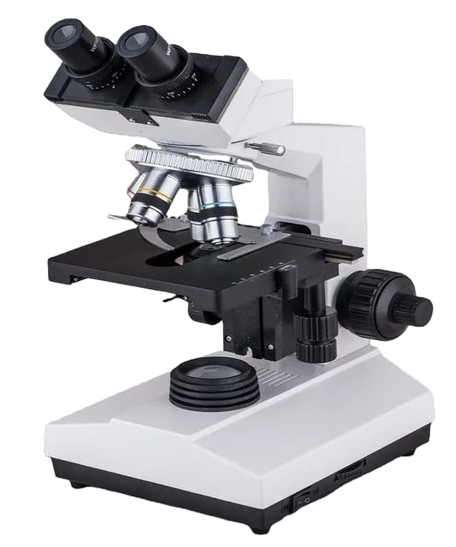
A Biological Microscope is an indispensable instrument for students, educators, and scientists who need precise visualization of microscopic structures. Designed to offer high-resolution imaging, it enables detailed observation of cells, bacteria, tissue samples, and other biological materials.
Equipped with adjustable objectives, fine and coarse focus, and reliable lighting, this microscope provides both clarity and convenience for laboratory tasks. Whether used for classroom demonstrations, clinical studies, or advanced research, a biological microscope ensures accurate, repeatable results.
Manufactured to rigorous scientific standards, it offers stability, precision, and ease of use—making it ideal for educational institutions, hospitals, and research labs.
Why Choose a Biological Microscope?
Clear Optics for Accurate Observation – Multi-lens system provides sharp, distortion-free images.
Stable and Durable Construction – Heavy-duty frame resists wear and maintains alignment over time.
Adjustable Light Source – LED or halogen illumination for bright, consistent viewing.
Ergonomic Design – Comfortable eyepiece angle and stage adjustments for prolonged use.
Educational & Research Applications – Perfect for biology classes, laboratory experiments, and clinical studies.
Key Features at a Glance
High-resolution objective lenses (usually 4x, 10x, 40x, 100x)
Rotatable nosepiece for easy lens switching
Coarse and fine focusing knobs
Mechanical stage with slide clips
LED/halogen illumination with intensity control
Durable metal frame for stability
Suitable for monocular or binocular observation
How to Use a Biological Microscope
Place the microscope on a flat, stable surface.
Switch on the light source and adjust intensity.
Place the specimen slide on the stage and secure it with stage clips.
Start with the lowest magnification objective and focus using the coarse knob.
Switch to higher magnifications and refine focus using the fine knob.
Clean lenses with lens paper after use; cover the microscope to prevent dust accumulation.
Who Should Use a Biological Microscope?
Students studying biology, microbiology, or life sciences
Laboratory technicians and researchers
Educators conducting classroom demonstrations
Hospitals and clinics requiring sample observation
Research institutions and scientific laboratories
Warnings & Precautions
Handle with care; avoid dropping or jarring the microscope.
Do not touch lenses with bare fingers to prevent smudges.
Use only lens paper for cleaning optical surfaces.
Switch off the illumination when not in use to prolong bulb life.
Keep in a dry, dust-free environment to maintain performance.
Buy a Biological Microscope at the Best Price from Pharmily
Equip your laboratory or classroom with a high-quality Biological Microscope from Pharmily, Kenya’s trusted supplier of scientific and educational instruments.
Reliable, high-precision optics
Durable and user-friendly design
Fast and secure delivery across Kenya
Order today and elevate your scientific observations with clarity and confidence.
FAQs
Q: What magnification levels does a biological microscope typically offer?
Most microscopes include objectives ranging from 4x to 100x, providing total magnifications up to 1000x with oil immersion lenses.
Q: Can it be used for clinical samples?
Yes, it is suitable for examining blood, tissue, bacteria, and other biological specimens.
Q: Is it suitable for students?
Absolutely. Designed for both educational and professional laboratory use.
Q: How should I maintain the microscope?
Clean lenses with lens paper, cover when not in use, and handle carefully to prevent damage.
There are no product reviews yet.