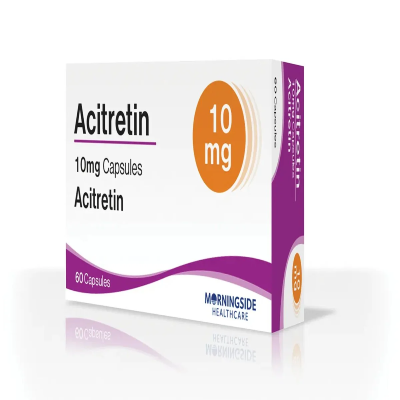
What is Acitretin and What Is It Used For?
Acitretin is a retinoid — a
medicine derived from vitamin A — used to treat severe, chronic skin conditions
that have not responded to other treatments. It works by regulating the
abnormal growth and shedding of skin cells, reducing the thickening, scaling,
and inflammation characteristic of psoriasis and related conditions.
Acitretin 10 mg is used for:
Severe psoriasis (all forms, including plaque, pustular, and erythrodermic
psoriasis) that is resistant to standard therapies; Other severe disorders of
keratinisation such as Darier's disease (keratosis follicularis), pityriasis
rubra pilaris, and congenital ichthyosis.
Acitretin is a highly effective
medicine for severe psoriasis, but its use requires careful monitoring and very
strict precautions in women of childbearing age due to its teratogenicity.
2. How to Take This Medicine
The dose is highly individualised.
Your dermatologist will start you on a low dose and adjust based on response
and tolerability.
Typical Adult Doses
•
Starting dose: 25–30 mg
daily (2–3 capsules of 10 mg), taken with food.
•
Maintenance dose: 25–50 mg
daily, adjusted according to response (usually after 3–4 weeks).
•
Maximum dose: 50 mg daily
(prescribed by specialist only).
Always take acitretin capsules
with food or milk — this significantly improves absorption. Swallow whole; do
not chew.
3. Side Effects
Very Common Side Effects (affect most patients)
•
Dry lips, mouth, and skin —
carry lip balm and use moisturisers regularly.
•
Dry, itchy, or inflamed
eyes.
•
Increased sensitivity to
sunlight (photosensitivity).
•
Hair thinning (reversible
after stopping treatment).
•
Nosebleeds and nasal
dryness.
•
Elevated blood lipids
(triglycerides and cholesterol) — requires blood monitoring.
Serious Side Effects
•
Liver toxicity — yellowing
of eyes/skin (jaundice), abdominal pain, dark urine.
•
Raised intracranial
pressure — severe headaches, vision disturbances, nausea.
•
Severe depression or mood
changes.
•
Bone pain or joint changes
on long-term use.
4. Contraindications — Who Should NOT Take
This Medicine
|
Do not take Acitretin
if you: •
You are pregnant or
trying to become pregnant (ABSOLUTE contraindication). •
You may become pregnant
and are not using two effective forms of contraception. •
You are breastfeeding. •
You have severe liver
disease or significantly elevated liver enzymes. •
You have severe kidney
disease. •
You take methotrexate or
tetracycline antibiotics. •
You are allergic to
acitretin, tretinoin, or any other retinoid. •
You consume alcohol
regularly (see below). |
5. Safety Warnings and Special Precautions
CRITICAL: Pregnancy Prevention Programme
Acitretin is EXTREMELY teratogenic
— it causes severe birth defects in virtually every case of foetal exposure.
Women of childbearing potential MUST use two effective forms of contraception
(e.g., combined oral contraceptive pill PLUS barrier method) starting at least
1 month before treatment, throughout treatment, and for a minimum of 2 years
AFTER stopping acitretin. Pregnancy testing is required before, during, and
after treatment.
Alcohol Prohibition
Alcohol must be completely avoided
during treatment and for 2 months after stopping. Alcohol converts acitretin
back to etretinate, which has an extremely long half-life and remains
teratogenic for up to 2 years.
Blood Donation
Do not donate blood during
treatment or for 2 years after stopping acitretin. Donated blood could expose a
pregnant recipient to the drug.
Sun Exposure
Acitretin increases skin
sensitivity to sunlight. Always use SPF 30+ sunscreen, wear protective
clothing, and avoid prolonged sun exposure.
6. Drug Interactions
•
Methotrexate — absolutely
contraindicated; both are hepatotoxic.
•
Tetracycline antibiotics
(doxycycline, tetracycline) — increased risk of raised intracranial pressure.
•
Alcohol — converts
acitretin to long-acting etretinate; strictly contraindicated.
•
Vitamin A supplements —
additive toxicity risk; avoid all vitamin A and retinoid-containing products.
•
Combined oral contraceptive
pills — progestogen-only 'mini-pills' may be inadequate; two methods required.
7. Storage Instructions
•
Store below 25°C in a dry
place, away from light.
•
Keep in the original pack.
•
Keep out of reach of
children.
•
Do not use past the expiry
date.
8. Prescription Status in Kenya
Acitretin is a prescription-only
medicine (POM) in Kenya, dispensed exclusively on the prescription of a
registered dermatologist. Due to teratogenicity, dispensing must comply with
the Pregnancy Prevention Programme requirements.
9. Patient Guidance
|
Important Reminders for
Patients •
WOMEN: Use two forms of
contraception from 1 month before, throughout, and for 2 years after
treatment. •
Never drink alcohol
during treatment or for 2 months after stopping. •
Do not donate blood
during treatment or for 2 years after stopping. •
Apply moisturiser to your
lips and skin daily to manage dryness. •
Use sunscreen (SPF 30+)
every day, even on cloudy days. •
Keep all blood test
appointments — liver and lipid monitoring is essential. •
Contact your doctor
immediately if you develop severe headaches, vision changes, or symptoms of
depression. |
10. Pharmacist / Prescriber Notes
•
Baseline investigations:
LFTs, fasting lipid profile, pregnancy test (women of childbearing potential),
FBC, renal function.
•
Ongoing monitoring: LFTs
and fasting lipids at 1 month, then every 3 months. Pregnancy test monthly in
women.
•
If triglycerides rise
>800 mg/dL, suspend treatment — pancreatitis risk.
•
Progestogen-only
contraceptives (mini-pill) are insufficient for contraception — patients need
two methods, one of which should be a barrier method.
•
Dispensing pharmacists must
document consent and contraceptive status in women of childbearing age.
11. Frequently Asked Questions (FAQs)
What is acitretin used for?
Acitretin is used to treat severe
psoriasis and other serious skin conditions affecting the normal growth of skin
cells. It works by normalising the rate at which skin cells grow and shed.
Why can't I drink alcohol while
taking acitretin?
Alcohol causes acitretin to be
converted in your body into etretinate, which has a very long half-life (up to
2 years) and is also highly teratogenic (causes birth defects). Even moderate
drinking during or after treatment creates a serious risk.
How long do I need to use
contraception after stopping acitretin?
Women of childbearing potential
must use two effective forms of contraception for a minimum of 2 years after
taking the last dose of acitretin, due to the risk of etretinate formation
persisting in the body.
Why is my skin and lips so dry
on acitretin?
Dryness of the lips, skin, and
eyes is a very common and expected effect of retinoids. Use a rich lip balm and
moisturiser daily. Eye drops can help with dry eyes. These effects are
manageable and confirm the medicine is working.
Will my hair grow back after
stopping acitretin?
Hair thinning is a common side
effect during treatment, but it is usually reversible — hair typically grows
back to normal once the medicine is stopped.
Can men take acitretin without
restrictions?
Men do not carry the same
pregnancy risk, but they should also not donate blood during treatment or for 2
years after. Regular liver and lipid monitoring is required for all patients.
Can I take vitamin A
supplements with acitretin?
No. Vitamin A supplements
(including high-dose multivitamins) must be avoided as they can cause additive
vitamin A toxicity (hypervitaminosis A).
How long before I see results
with acitretin?
Improvement in psoriasis typically
begins after 3–4 weeks of treatment. Full benefit is usually seen at 4–6
months. Do not stop early unless advised by your dermatologist.
There are no product reviews yet.