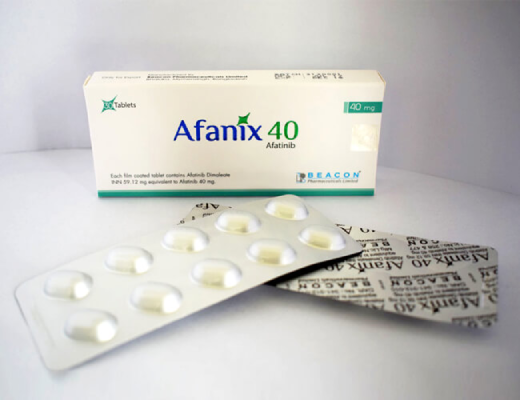
What is AFANIX and What Is It Used For?
AFANIX contains afatinib, a
targeted cancer medicine that works by blocking the action of certain proteins
(ErbB receptors, including EGFR and HER2) found on the surface of cancer cells.
By blocking these signals, afatinib slows or stops the growth of cancer cells.
Afatinib 40 mg is indicated for:
First-line treatment of adults with non-small cell lung cancer (NSCLC) with
specific EGFR mutations (deletion of exon 19 or substitution in exon 21 L858R);
Treatment of adults with locally advanced or metastatic squamous cell carcinoma
of the lung after prior platinum-based chemotherapy.
Afatinib is an irreversible ErbB
family blocker, distinguishing it from first-generation EGFR inhibitors such as
erlotinib and gefitinib. Selecting patients with confirmed EGFR mutations is
essential before initiating therapy.
2. How to Take This Medicine
The recommended dose is 40 mg
taken ONCE daily. Take on an empty stomach — at least 1 hour before or 3 hours
after eating. Swallow whole with water.
•
Take at the same time every
day.
•
If you miss a dose, take it
as soon as you remember — unless the next dose is within 8 hours. If so, skip
and continue with the next scheduled dose.
•
Your doctor may reduce your
dose to 30 mg or 20 mg if you experience significant side effects.
Dose Reductions
•
Dose reductions are in 10
mg steps (40 mg → 30 mg → 20 mg).
•
A minimum dose of 20 mg is
supported in clinical trials.
3. Side Effects
Very Common Side Effects (>1 in 10 patients)
•
Diarrhoea — often severe;
start an antidiarrhoeal (loperamide) at first sign and maintain hydration.
Report if it persists >48 hours.
•
Skin rash / acneiform rash
— appears on face, chest, back; topical treatments can help.
•
Paronychia —
inflammation/infection around the fingernails and toenails.
•
Dry skin, stomatitis (mouth
sores).
•
Nausea, decreased appetite,
vomiting.
Serious Side Effects — Seek Urgent Medical Attention
•
Interstitial lung disease
(ILD) / pneumonitis — new or worsening breathlessness, cough, fever. Stop
afatinib and seek emergency help.
•
Severe diarrhoea causing
dehydration.
•
Severe skin reactions:
blistering, peeling, mucous membrane involvement.
•
Eye inflammation
(keratitis): eye pain, redness, blurred vision.
•
Heart problems: reduced
left ventricular ejection fraction.
4. Contraindications — Who Should NOT Take
This Medicine
|
Do not take AFANIX if
you: •
You are allergic to
afatinib or any ingredient in the tablet. |
5. Safety Warnings and Special Precautions
Diarrhoea Management
Diarrhoea is the most common
dose-limiting side effect. At the first sign of loose stools, start loperamide
as directed and maintain good fluid intake. Report to your oncologist if
diarrhoea continues for more than 48 hours or is severe.
Skin and Nail Care
Skin rash is expected with EGFR
inhibitors and can be a sign that the drug is active. Use gentle, non-perfumed
moisturisers. Keep nails short and clean to prevent paronychia. Wear gloves
when gardening or doing wet work.
Pregnancy and Breastfeeding
Afatinib can harm an unborn baby.
Women must use effective contraception during treatment and for at least 2
weeks after the last dose. Breastfeeding is not recommended.
Sun Protection
The skin rash worsens with sun
exposure. Use SPF 30+ sunscreen and protective clothing daily.
6. Drug Interactions
•
P-glycoprotein (P-gp)
inhibitors (e.g., ritonavir, cyclosporine, ketoconazole, erythromycin) —
increase afatinib exposure; reduce afatinib dose by 10 mg if not tolerated.
•
P-gp inducers (e.g.,
rifampicin, carbamazepine, phenytoin, St John's Wort) — decrease afatinib
exposure; increase afatinib dose by 10 mg if tolerated.
7. Storage Instructions
•
Store below 25°C in a dry
place, away from direct light.
•
Keep in the original bottle
with the desiccant (silica gel sachet) — do not remove it.
•
Keep out of reach of
children.
8. Prescription Status in Kenya
AFANIX is a prescription-only
medicine (POM) in Kenya. It must only be initiated by a qualified oncologist
following molecular testing confirming EGFR mutation status.
9. Patient Guidance
|
Important Reminders for
Patients •
Take AFANIX on an empty
stomach — at least 1 hour before or 3 hours after any food. •
Keep a supply of
loperamide (anti-diarrhoeal) at home and start it at the first sign of loose
stools. •
Protect your skin from
sun exposure — use SPF 30+ sunscreen daily. •
Keep nails clean and
short to help prevent nail infections. •
Contact your oncologist
immediately if you develop new or worsening breathing difficulties. •
Do not stop treatment
without first talking to your oncologist — EGFR TKI interruptions can lead to
rapid disease progression. |
10. Pharmacist / Prescriber Notes
•
Patient selection: Confirm
EGFR mutation (exon 19 deletion or L858R substitution) before initiating
first-line afatinib.
•
Hepatic impairment: No dose
adjustment for mild-moderate. Not recommended in severe hepatic impairment
(Child-Pugh C).
•
Renal impairment: No
adjustment for CrCl ≥15 mL/min. Avoid if CrCl <15 mL/min (insufficient
data).
•
Monitor: LFTs, renal
function, LVEF (cardiac function), respiratory symptoms.
•
Afatinib should be taken at
the same time each day relative to P-gp inhibitors (12 hours apart where
possible).
11. Frequently Asked Questions (FAQs)
What is AFANIX (afatinib) used
for?
AFANIX is a targeted therapy for
non-small cell lung cancer (NSCLC). It is used as a first-line treatment in
patients whose cancer has specific EGFR gene mutations, or as a second-line
treatment for advanced squamous lung cancer.
Do I need a genetic test before
starting AFANIX?
Yes. Your tumour must be tested
for EGFR mutations (specifically exon 19 deletions or L858R mutation in exon
21) before starting afatinib. Without confirmed mutation, afatinib is not
indicated for first-line NSCLC.
Why must I take AFANIX on an
empty stomach?
A high-fat meal can reduce
afatinib absorption by up to 50%. Taking it at least 1 hour before food or 3
hours after ensures reliable blood levels.
What should I do if I get
diarrhoea?
Start loperamide (e.g., Imodium)
immediately at the first sign of loose stools and maintain fluid intake. If
diarrhoea persists beyond 48 hours or is severe, contact your oncologist — you
may need a dose reduction or temporary interruption.
What does the skin rash mean?
Should I be worried?
An acneiform (pimple-like) rash on
the face, chest, and back is common and is often a sign that the drug is
working. Use gentle moisturisers and SPF 30+ sunscreen. Report severe rashes
(blistering, peeling) to your oncologist.
There are no product reviews yet.