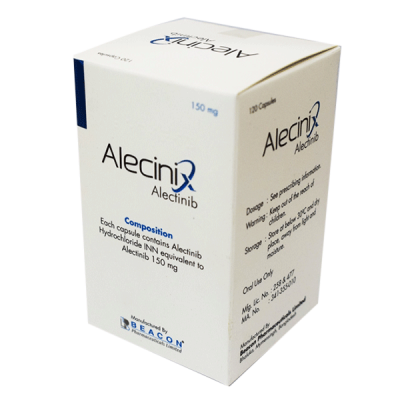
What is ALECINIX and What Is It Used For?
ALECINIX contains alectinib, a
targeted cancer medicine that works by blocking a faulty protein called ALK
(Anaplastic Lymphoma Kinase). In some patients with non-small cell lung cancer
(NSCLC), a genetic rearrangement in the ALK gene causes the ALK protein to
drive cancer cell growth. By inhibiting ALK, alectinib shuts down this signal
and slows or stops cancer growth.
Alectinib 150 mg is indicated for:
First-line treatment of adults with ALK-positive, locally advanced or
metastatic NSCLC; Treatment of adults with ALK-positive advanced NSCLC
previously treated with crizotinib.
Alectinib has excellent CNS
(brain) penetration, making it particularly effective for patients with brain
metastases. The standard dose is 600 mg (4 × 150 mg capsules) taken twice
daily.
2. How to Take This Medicine
The recommended dose is 600 mg
(four 150 mg capsules) taken TWICE DAILY with food. Take capsules with a full
meal to ensure adequate absorption.
•
Morning dose: 600 mg (4
capsules) with breakfast.
•
Evening dose: 600 mg (4
capsules) with dinner or main evening meal.
•
Swallow capsules whole — do
not open, dissolve, or chew.
•
If you vomit after a dose,
do not retake it — wait until the next scheduled dose.
•
If you miss a dose, take it
as soon as you remember — unless the next dose is within 6 hours. In that case,
skip the missed dose.
Dose Reductions
•
Dose reductions in 150 mg
steps: 600 mg BD → 450 mg BD → 300 mg BD, based on tolerability.
3. Side Effects
Common Side Effects
•
Constipation, nausea,
vomiting, diarrhoea.
•
Fatigue and muscle pain
(myalgia).
•
Oedema (swelling) —
especially peripheral oedema.
•
Elevated liver enzymes
(AST, ALT, bilirubin) — detected on blood tests.
•
Elevated creatinine
(reduced kidney function markers).
•
Anaemia and raised CPK
(muscle enzyme).
Serious Side Effects — Report Immediately
•
Interstitial lung disease /
pneumonitis — worsening breathlessness, cough, fever. Requires immediate
treatment interruption.
•
Severe liver toxicity —
yellowing of skin/eyes, dark urine, severe abdominal pain.
•
Bradycardia (slow
heartbeat) — dizziness, fainting, chest pain.
•
Severe myopathy — extreme
muscle pain, weakness, dark (brown) urine (rhabdomyolysis).
•
Photosensitivity reactions
— severe sun sensitivity.
4. Contraindications — Who Should NOT Take
This Medicine
|
Do not take ALECINIX if
you: •
You are allergic to
alectinib or any ingredient in the capsule. |
5. Safety Warnings and Special Precautions
Liver Toxicity
Alectinib can cause elevated liver
enzymes. Regular liver function tests are required every 2 weeks for the first
3 months, then monthly. Report any yellowing of skin or eyes, dark urine, or
right upper abdominal pain immediately.
Muscle Problems (Myopathy / Rhabdomyolysis)
Rare but serious muscle breakdown
can occur. Report severe muscle pain, weakness, or dark urine to your
oncologist immediately.
Heart Rate
Alectinib can slow the heart rate
(bradycardia). Tell your doctor if you feel dizzy, faint, or have an unusually
slow pulse.
Photosensitivity
Alectinib increases skin
sensitivity to sunlight. Avoid prolonged sun exposure, use SPF 30+ sunscreen,
and wear protective clothing — especially from 10 am to 4 pm.
Pregnancy and Breastfeeding
Women of childbearing potential
must use effective contraception during treatment and for 3 months after the
last dose. Breastfeeding is not recommended.
6. Drug Interactions
•
Strong CYP3A4 inhibitors
(e.g., ketoconazole, itraconazole, ritonavir) — may increase alectinib
exposure; use with caution.
•
Strong CYP3A4 inducers
(e.g., rifampicin, carbamazepine, phenytoin, St John's Wort) — significantly
reduce alectinib levels; avoid.
•
Drugs causing bradycardia
(beta-blockers, digoxin, diltiazem) — additive risk of slow heart rate.
7. Storage Instructions
•
Store below 30°C in a dry
place, away from light and moisture.
•
Keep in the original
packaging.
•
Keep out of reach of
children.
8. Prescription Status in Kenya
ALECINIX is a prescription-only
specialist medicine (POM) in Kenya. Must only be initiated by an oncologist
following molecular testing confirming ALK-positive NSCLC.
9. Patient Guidance
|
Important Reminders for
Patients •
Take ALECINIX with food —
twice daily with a full meal. •
Protect your skin from
sun exposure every day — use SPF 30+ sunscreen. •
Keep all liver function
blood test appointments. •
Report any muscle pain,
weakness, or dark urine immediately. •
Tell your doctor if you
feel dizzy or your heart rate feels very slow. •
Do not stop taking
ALECINIX without consulting your oncologist. •
Women: use reliable
contraception during treatment and for 3 months after stopping. |
10. Pharmacist / Prescriber Notes
•
Confirm ALK-positive NSCLC
status by validated test (FISH, IHC, or RT-PCR) before initiating.
•
Monitor: LFTs every 2 weeks
for 3 months then monthly; CPK and creatinine periodically; heart rate and ECG
in at-risk patients.
•
Hepatic impairment: No
adjustment for mild impairment. Moderate: reduce to 450 mg BD. Severe: no data
— avoid.
•
Renal impairment: No
adjustment for mild-moderate. Severe: caution, limited data.
•
Alectinib penetrates the
CNS well and is effective for brain metastases — preferred over crizotinib in
this setting.
11. Frequently Asked Questions (FAQs)
Do I need a genetic test before
starting ALECINIX?
Yes. Your oncologist must confirm
ALK rearrangement in your tumour using a validated diagnostic test (FISH,
immunohistochemistry, or RT-PCR) before starting treatment.
Why do I take 4 capsules at
once?
Each capsule contains 150 mg of
alectinib, and the recommended dose is 600 mg (4 × 150 mg) taken twice daily
with food. This dosing was established in clinical trials to achieve effective
blood levels.
Can alectinib treat cancer that
has spread to the brain?
Yes. One of the major advantages
of alectinib is its ability to penetrate the blood-brain barrier and treat
brain metastases, making it a preferred choice over older ALK inhibitors like
crizotinib for patients with CNS involvement.
Why is it important to take
ALECINIX with food?
Food significantly increases the
absorption of alectinib. Taking it on an empty stomach results in much lower
blood levels, reducing its effectiveness.
What should I do about sun
sensitivity?
Always apply SPF 30+
broad-spectrum sunscreen to exposed skin, wear protective clothing, and avoid
direct sun between 10 am and 4 pm. Phototoxic reactions can be severe with
alectinib.
There are no product reviews yet.