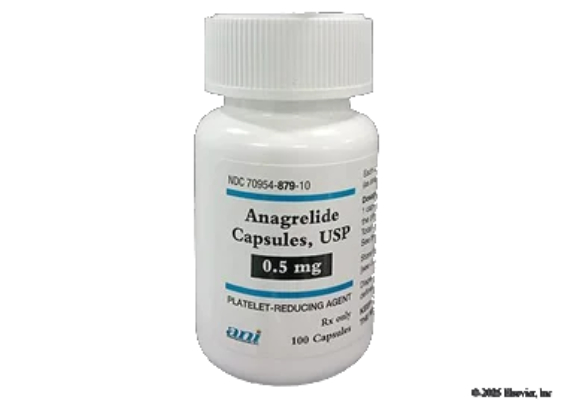
What is Anagrelide and What Is It Used For?
Anagrelide is a medicine that
reduces the number of platelets (blood cells involved in clotting) in the
bloodstream. It works by inhibiting megakaryocyte maturation — blocking the
development of the bone marrow cells that produce platelets. This reduces the
risk of thrombotic (clotting) and haemorrhagic (bleeding) complications seen
when platelet counts are dangerously high.
Anagrelide 0.5 mg is indicated
for: Essential Thrombocythaemia (ET) — a rare bone marrow disorder causing
overproduction of platelets, when first-line cytoreductive therapy is not
appropriate or has failed; Some cases of other myeloproliferative disorders
with thrombocytosis in high-risk patients.
Anagrelide is typically reserved
for high-risk ET patients (age >60, history of thrombosis, very high
platelet count >1500 × 10⁹/L, or cardiovascular risk factors).
2. How to Take This Medicine
The starting dose is 0.5 mg four
times daily or 1 mg twice daily, taken for at least 1 week before any
adjustment.
•
Usual starting dose: 0.5 mg
4 times daily (or 1 mg twice daily).
•
Dose titration: Increase by
no more than 0.5 mg/day each week until platelet count falls to <600 × 10⁹/L
(ideally to the normal range).
•
Usual maintenance dose: 1–3
mg/day in divided doses.
•
Maximum dose: 10 mg/day or
2.5 mg as a single dose.
Take with or without food.
Capsules should be swallowed whole. Consistent timing is important — take at
the same times each day.
3. Side Effects
Common Side Effects (particularly at treatment initiation)
•
Headache — often mild and
occurs early; usually improves with continued treatment.
•
Palpitations and increased
heart rate (tachycardia) — especially in the first days of treatment.
•
Fluid retention and oedema
— ankle swelling.
•
Diarrhoea, nausea,
abdominal pain.
•
Dizziness, fatigue.
Serious Side Effects — Report Immediately
•
Cardiac effects: chest
pain, shortness of breath, severe palpitations — anagrelide can worsen heart
failure and cause cardiomegaly (enlarged heart).
•
Anaemia: pallor, extreme
fatigue, shortness of breath.
•
Pulmonary hypertension:
breathlessness, fatigue, leg swelling.
•
Severe headache that is
persistent or worsening.
•
Thrombotic events (blood
clots) — despite treatment, if platelet count control is inadequate.
4. Contraindications — Who Should NOT Take
This Medicine
|
Do not take Anagrelide
if you: •
You have moderate or
severe liver disease (hepatic impairment — Child-Pugh B or C). •
You have severe kidney
disease (CrCl <30 mL/min). •
You have heart failure,
angina, or clinically significant QT prolongation. •
You are pregnant or
planning pregnancy. •
You are allergic to
anagrelide or any ingredient in the capsule. |
5. Safety Warnings and Special Precautions
Cardiac Monitoring Essential
Anagrelide has positive
chronotropic and inotropic cardiac effects (increases heart rate and force of
contraction) which can worsen pre-existing heart disease. An ECG and
echocardiogram are recommended before starting treatment and periodically
thereafter.
Pregnancy
Anagrelide must not be used during
pregnancy. Women of childbearing potential must use effective contraception
during treatment. Animal studies show harmful effects on foetal development. If
pregnancy occurs during treatment, stop anagrelide immediately and discuss
alternative management with your haematologist.
Platelet Monitoring
Regular full blood count (FBC)
including platelet count monitoring is essential to guide dose adjustments. The
goal is to normalise platelet count (typically <400–600 × 10⁹/L) without
causing thrombocytopenia (dangerously low platelet count <100 × 10⁹/L).
6. Drug Interactions
•
Other phosphodiesterase III
inhibitors (e.g., milrinone, cilostazol) — additive platelet-inhibiting
effects; avoid combination.
•
Anticoagulants and
antiplatelet agents (aspirin, clopidogrel, warfarin, heparin) — increased
bleeding risk; use with caution.
•
Sucralfate — may reduce
absorption of anagrelide; take at different times.
•
Foods/medicines affecting
CYP1A2 (e.g., fluvoxamine, ciprofloxacin) — may increase anagrelide levels.
•
QT-prolonging medicines —
additive risk of cardiac arrhythmia.
7. Storage Instructions
•
Store below 25°C, in a dry
place, away from light.
•
Keep in the original
packaging.
•
Keep out of reach of
children.
8. Prescription Status in Kenya
Anagrelide is a prescription-only
medicine (POM) in Kenya. It must only be initiated and supervised by a
haematologist or specialist physician experienced in the management of
myeloproliferative disorders.
9. Patient Guidance
|
Important Reminders for
Patients •
Take your capsules at the
same times every day. •
Never miss a blood count
monitoring appointment — your platelet count guides your dose. •
Tell your doctor
immediately if you experience chest pain, severe palpitations, or shortness
of breath. •
Women: use reliable
contraception throughout treatment — anagrelide must not be taken during
pregnancy. •
Do not suddenly stop
anagrelide without your haematologist's guidance. •
Carry a medicine
information card with your diagnosis and current dose. |
10. Pharmacist / Prescriber Notes
•
Monitor FBC (including
platelets) every 2 weeks until stable, then monthly.
•
Baseline and periodic: ECG,
echocardiogram (cardiac function), LFTs, renal function.
•
Hepatic impairment: Mild
(Child-Pugh A): use with caution and halve starting dose. Moderate-severe:
contraindicated.
•
Renal impairment: CrCl
30–59 mL/min: use with caution. <30 mL/min: contraindicated.
•
Target platelet count:
<600 × 10⁹/L (some guidelines target normal range <400 × 10⁹/L).
•
Compared to hydroxyurea:
anagrelide is platelet-selective (does not reduce WBC or RBC) but has more
cardiovascular side effects; hydroxyurea preferred as first-line in most
guidelines.
11. Frequently Asked Questions (FAQs)
Why do I feel palpitations when
I start anagrelide?
Anagrelide affects the heart muscle
directly, increasing the heart rate and force of contraction — especially in
the first days of treatment. These palpitations are common and usually decrease
over time. However, always report severe palpitations or chest pain
immediately.
How long will I need to take
anagrelide?
Anagrelide is typically a long-term treatment. Essential thrombocythaemia is a chronic condition, and anagrelide controls (but does not cure) the platelet overproduction. Treatment duration is guided by your haematologist.
Will anagrelide affect my other
blood cells?
Anagrelide is platelet-selective.
Unlike hydroxyurea, it does not significantly reduce red blood cells or white
blood cells. However, anaemia can still occur in some patients.
Can I take aspirin with
anagrelide?
Low-dose aspirin is sometimes
co-prescribed with anagrelide for high-risk ET patients. However, combining
anagrelide with aspirin increases bleeding risk and should only be done under
specialist guidance with careful monitoring.
Is anagrelide safe during
pregnancy?
No — anagrelide must not be taken
during pregnancy. Women of childbearing age must use effective contraception
during treatment. If pregnancy is planned, discuss safe alternative treatments
(e.g., interferon-alpha) with your haematologist before stopping anagrelide.
There are no product reviews yet.