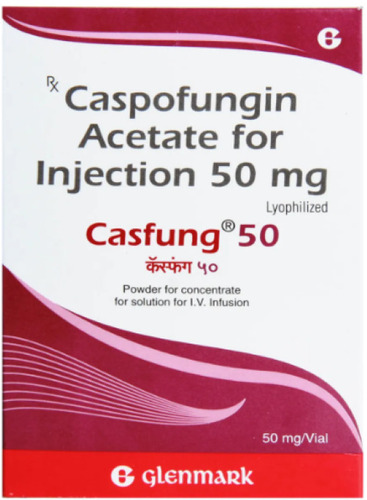
What is Caspofungin and What Is It Used For?
Caspofungin is a powerful antifungal medicine belonging to a class called echinocandins. It was the first echinocandin approved for clinical use (2001) and works by attacking the fungal cell wall — a structure that does not exist in human cells — making it highly selective against fungi with minimal human toxicity.
It is used to treat serious, invasive fungal infections in patients
who are critically ill, immunocompromised, or for whom other antifungals
have failed or cannot be tolerated. It is administered only by slow IV infusion
in a hospital setting.
Approved Uses
• Empirical antifungal treatment in
febrile, neutropenic patients (when a fungal infection is suspected but not
confirmed)
• Candidaemia (Candida fungus in the
bloodstream)
• Invasive Candida infections:
intra-abdominal abscesses, peritonitis, pleural space infections
• Oesophageal candidiasis (Candida
infection of the gullet)
• Invasive aspergillosis — in patients
who are refractory to or intolerant of other antifungals (e.g. amphotericin B,
itraconazole)
2. How to Take This Medicine
|
⚠ Administer by SLOW IV infusion over
approximately 1 hour. Do NOT give as a rapid IV bolus — increases infusion
reactions. Do NOT mix with other medications in the same IV line. Do NOT use
dextrose-containing diluents. |
Adults — Most Indications
• Loading dose: 70 mg IV on Day 1
• Maintenance: 50 mg IV once daily from
Day 2 onward
• Duration: Based on clinical response
and resolution of infection — typically 14 days beyond resolution of
candidaemia or last positive culture (6-12 weeks)
Adults — Oesophageal Candidiasis
• 70 mg on day 1, then 50 mg IV once
daily (no loading dose required)
• Duration: 7–14 days
Patients on CYP3A4 Inducers (rifampicin, nevirapine,
carbamazepine, phenytoin, dexamethasone)
• Consider increasing the maintenance dose
to 70 mg/day
Children (3 months to 17 years)
• Loading dose: 70 mg/m² (maximum 70
mg) on Day 1
• Maintenance: 50 mg/m² (maximum 50 mg)
once daily
Hepatic Impairment — Moderate (Child-Pugh B)
• Reduce maintenance dose to 35 mg/day
3. Side Effects
Common (may affect more than 1 in 10 patients)
• Fever
• Nausea and vomiting
• Phlebitis or thrombophlebitis at the
infusion site
• Tachycardia (increased heart rate)
• Rash and skin flushing
• Headache and diarrhoea
• Elevated liver enzymes (ALT, AST) —
monitor liver function
Serious — Tell Your Doctor or Nurse Immediately
• Severe allergic reactions /
anaphylaxis: Stop infusion immediately; treat with adrenaline, antihistamines,
corticosteroids
• Severe skin reactions:
Stevens-Johnson Syndrome (SJS) and toxic epidermal necrolysis (TEN) — rare but
potentially fatal; stop immediately if a severe rash develops
• Significant hepatotoxicity:
Discontinue if serious liver injury occurs
4. Contraindications — Who Should NOT Receive
This Medicine
• Known hypersensitivity to caspofungin
or any ingredient in the formulation
• Co-administration with cyclosporine:
Not recommended unless clearly essential — risk of additive hepatotoxicity and
elevated caspofungin levels
5. Safety Warnings and Special Precautions
Pregnancy
Limited data. Caspofungin caused fetal abnormalities in animal studies.
Use only if the potential benefit clearly outweighs the risk — serious fungal
infections in pregnancy carry significant maternal risk.
Breastfeeding
Unknown if caspofungin passes into breast milk. Exercise caution — weigh
benefits against risks.
Children under 3 Months
Safety and efficacy not established in neonates. Not recommended.
Liver Disease
Monitor liver function tests before and throughout treatment. Dose
reduction required for moderate hepatic impairment. Safety in severe liver
disease not established.
6. Drug Interactions
• Cyclosporine: Significant increase in
caspofungin exposure (~35%) and potential additive hepatotoxicity — avoid
concurrent use; monitor LFTs closely if unavoidable
• Rifampicin, nevirapine, efavirenz,
carbamazepine, phenytoin, dexamethasone (CYP3A4 inducers): Reduce caspofungin
levels — increase maintenance dose to 70 mg/day
• Tacrolimus: Caspofungin may decrease
tacrolimus blood levels by ~20% — monitor tacrolimus levels and adjust dose as
needed
• St John's Wort (herbal CYP inducer):
May reduce caspofungin effectiveness — avoid
• Do NOT mix with other IV drugs or
dextrose-containing solutions — incompatible
7. Storage
• Unopened vials: Refrigerate at 2–8°C
• After reconstitution: Stable for up
to 1 hour at room temperature (≤25°C)
• Diluted infusion solution: Use within
24 hours at room temperature or 48 hours if refrigerated
• Single use only — discard any unused
portion
8. Prescription Status
POM — Prescription Only Medicine. Hospital use only; administered by
trained healthcare professionals.
9. Patient Guidance
If you are receiving caspofungin, you will be in the hospital and closely
monitored by your medical team. Tell your nurse or doctor immediately if you
notice: an increasing rash, difficulty breathing, a feeling of throat tightening,
or any unusual symptoms during or after your infusion.
10. Pharmacist / Prescriber Notes
• Loading dose is essential: Without
the 70 mg loading dose, therapeutic steady-state is not reached for several
days — always prescribe the loading dose on Day 1
• Fungistatic vs fungicidal:
Caspofungin is fungicidal against Candida but only fungistatic against
Aspergillus — combination therapy with voriconazole may be considered for
severe aspergillosis
• EUCAST susceptibility: Check local
epidemiology — Candida auris and some Candida glabrata strains may have reduced
echinocandin susceptibility
• Monitoring: LFTs twice weekly; blood
cultures every 48 hours until clearance; assess for metastatic foci
(echocardiogram in candidaemia)
• Tacrolimus interaction: Critical in
transplant patients — check tacrolimus trough levels twice weekly when starting
or stopping caspofungin
• Cyclosporine: Avoid concurrent use
due to hepatotoxicity; if unavoidable, monitor LFTs daily
11. Frequently Asked Questions (FAQs)
Q: Why am I receiving an antifungal if nobody has confirmed
I have a fungal infection?
A: In patients with a weakened immune
system and a fever that has not responded to antibiotics, a fungal infection is
strongly suspected even without laboratory confirmation. Starting antifungal
treatment promptly prevents a potential fungal infection from becoming
life-threatening. If cultures later confirm a bacterial cause, antifungal
therapy will be reviewed.
Q: Is caspofungin an antibiotic?
A: Caspofungin is an antifungal
antibiotic — meaning it fights fungal infections, not bacterial ones. Standard
antibiotics (penicillins, cephalosporins, etc.) do not affect fungi.
Different types of infecting organisms require completely different types of
treatment.
Q: How will the medical team know if caspofungin is
working?
A: Your temperature should start
reducing within 3–5 days. Blood cultures will be repeated every 48 hours to
confirm fungal clearance. Your doctors will also monitor your inflammatory
markers (CRP, white cell count) and imaging results to assess your response.
There are no product reviews yet.