WHAT IS THIS MEDICINE?
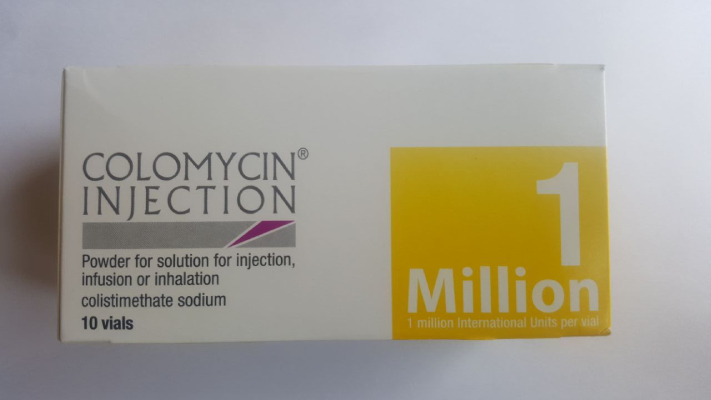
Colomycin contains colistimethate sodium (a prodrug of
colistin), a polymyxin antibiotic reserved for serious infections caused by
multidrug-resistant (MDR) Gram-negative bacteria such as Pseudomonas
aeruginosa, Acinetobacter baumannii, and Klebsiella pneumoniae. Because of its
toxicity profile, it is used only when other antibiotics are ineffective.
2. HOW TO TAKE THIS MEDICINE
Administered exclusively by intravenous (IV) infusion in a
hospital/clinical setting. The dose is expressed in Million International Units
(MIU).
Bronchiectasis, exacerbation prevention - Inhalation for nebulization
(off-label route): 30 to 150 mg colistin base activity (CBA) via nebulizer
once or twice daily (maximum dose: 150 mg CBA twice daily)
Cystic Fibrosis – 2.5 – 5 mg/kg/day colistin base activity (CBA) in 3 divided doses
Gram-negative infection, extensively drug resistant – 300 mg colistin CBA loading dose
followed 12 hours later with 150-180 mg CBA twice daily.
3. POSSIBLE SIDE EFFECTS
Common side effects include the following. Contact your
doctor or pharmacist if any side effect worries you.
|
Side Effect |
Frequency |
What To Do |
|
Nephrotoxicity (kidney damage) |
Common |
Renal function monitored closely |
|
Neurotoxicity (tingling, confusion) |
Common |
Dose reduction may be needed |
|
Bronchoconstriction (if inhaled) |
Common |
Pre-treatment bronchodilator used |
|
Elevated creatinine |
Very common |
Daily renal monitoring in ICU |
|
Apnoea (respiratory arrest) |
Rare |
Emergency equipment must be available |
|
Hypokalaemia |
Uncommon |
Monitor electrolytes regularly |
|
Pain at the injection site |
Common (IM) |
IV route preferred to reduce pain |
|
⚠ IMPORTANT WARNING |
|
Colistin can cause serious and potentially
irreversible kidney damage and neurotoxicity. Renal function must be
monitored daily in hospitalised patients. Use only when no other appropriate
antibiotic option is available — this is a last-resort antibiotic. |
4. WHO SHOULD NOT TAKE THIS MEDICINE
Contraindicated in patients with a known hypersensitivity to
colistin or polymyxins. Use with extreme caution in patients with pre-existing
renal impairment. Avoid concurrent use of other nephrotoxic agents
(aminoglycosides, vancomycin) unless essential.
5. DRUG INTERACTIONS
Concurrent nephrotoxic drugs (gentamicin, vancomycin,
amphotericin B, NSAIDs, ciclosporin) greatly increase the risk of kidney
damage. Non-depolarising muscle relaxants (vecuronium, atracurium) may have an enhanced effect, leading to prolonged paralysis.
6. HOW TO STORE
Store below 25°C. Protect from light. After reconstitution,
the solution must be used immediately or within the manufacturer's specified
timeframe at 2–8°C. Do not freeze the reconstituted solution.
7. PRESCRIPTION STATUS
Prescription Only Medicine (POM). Use is restricted to the hospital
setting by infectious disease physicians or microbiologists. Not for primary
care prescription.
|
💚 PATIENT TIP |
|
Colomycin injection is a very different product
from Colomycin inhalation powder. Always confirm the route of administration
with the prescribing physician — confusing the two formulations could be
dangerous. |
8. PHARMACIST'S NOTE
Colistin dosing is complex — currently expressed in MIU
(Million International Units) rather than mg, and conversion between
colistimethate sodium and colistin base activity (CBA) is critical to avoid
dosing errors. Refer to local antimicrobial stewardship protocols. Therapeutic
drug monitoring (TDM) for colistin is emerging as best practice.
9. FREQUENTLY ASKED QUESTIONS
|
FREQUENTLY ASKED QUESTIONS |
|
Q: Why is colistin called
a "last-resort" antibiotic? A: It is reserved for infections caused by
bacteria resistant to nearly all other antibiotics. Overuse would quickly
generate resistance, so it is used very selectively under antimicrobial
stewardship guidelines. |
|
Q: Can colistin be given
by nebuliser for lung infections? A: Yes — nebulised colistin is used in cystic
fibrosis and bronchiectasis patients with chronic Pseudomonas infection, but
this uses a different formulation and dose. Hospital injection vials should
not be used for inhalation without explicit guidance. |
|
Q: How long is a course
of colistin treatment? A: Treatment duration depends on the infection, but is typically 7–14 days. The shortest effective course is preferred to
minimise toxicity. |
|
Q: Is colistin used in
cystic fibrosis? A: Yes — nebulised colistin is one of the
mainstay maintenance therapies for chronic Pseudomonas aeruginosa infection
in cystic fibrosis patients. |
|
Q: Can colistin treat
MRSA? A: No — colistin is active only against
Gram-negative bacteria. MRSA is a Gram-positive organism and is not sensitive
to colistin. |
There are no product reviews yet.