
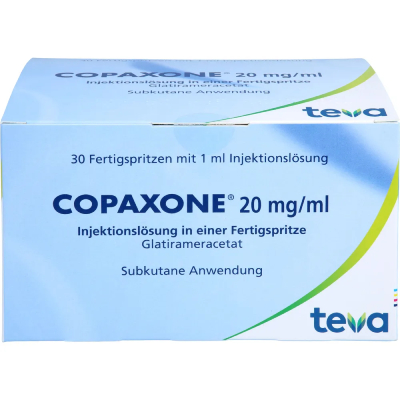
WHAT IS THIS MEDICINE?
Copaxone contains glatiramer acetate, a synthetic mixture of
amino acids that resembles myelin basic protein — a component of the nerve
sheath damaged in multiple sclerosis (MS). By "distracting" the
immune system from attacking myelin, it reduces the frequency of
relapsing-remitting MS (RRMS) episodes. It is one of the oldest and
best-established MS disease-modifying therapies.
2. HOW TO TAKE THIS MEDICINE
The 20mg once daily or 40 mg 2 times a week, administered at
least 48 hours apart dose is injected subcutaneously once daily. Injection
sites include the abdomen, thigh, upper arm, and buttock — rotate
systematically to prevent site reactions.
Injections should be given at the same time each day. The
auto-injector device makes self-injection easier. Remove from refrigerator 20
minutes before injection to reach room temperature.
3. POSSIBLE SIDE EFFECTS
Common side effects include the following. Contact your
doctor or pharmacist if any side effect worries you.
|
Side Effect |
Frequency |
What To Do |
|
Injection site reactions |
Very common |
Rotate sites; apply warm compress after
injection |
|
Lipoatrophy (skin dimpling) |
Common |
Strict site rotation minimises this risk |
|
Immediate post-injection reaction |
Common |
Flushing, chest tightness, palpitations —
passes in 15–30 min |
|
Flushing/vasodilation |
Common |
Lie down if this occurs; it resolves
spontaneously |
|
Chest pain |
Common (benign) |
Usually harmless; report to doctor if severe |
|
Lymphadenopathy (swollen nodes) |
Common |
Mention to the doctor at next appointment |
|
Asthenia (weakness) |
Common |
Usually improves as body adjusts to treatment |
|
⚠ IMPORTANT WARNING |
|
Approximately 10–15% of patients experience an
Immediate Post-Injection Reaction (IPIR) — a sudden episode of flushing,
chest tightness, palpitations, anxiety, and shortness of breath within
minutes of injection. This is not an allergic reaction and usually resolves
within 30 minutes without treatment. Lie down and rest; contact your doctor
if it occurs repeatedly. |
4. WHO SHOULD NOT TAKE THIS MEDICINE
Contraindicated in known hypersensitivity to glatiramer
acetate or mannitol. Not recommended in pregnancy — women planning pregnancy
should discuss disease management with their neurologist. Use with caution in
severe hepatic or renal impairment.
5. DRUG INTERACTIONS
No significant pharmacokinetic drug interactions. Concurrent
use of immunosuppressants should be discussed with the neurologist as combined
immunosuppression may increase infection risk.
6. HOW TO STORE
Store in refrigerator (2–8°C). Do not freeze. If
refrigeration is unavailable, can be stored at room temperature (below 25°C)
for up to 1 month. Keep in original packaging, away from light.
7. PRESCRIPTION STATUS
Prescription Only Medicine (POM). Initiated and monitored by
a neurologist specialising in multiple sclerosis. Ongoing supply may be managed
in primary care.
|
💚 PATIENT TIP |
|
Keep an injection site diary or use the
rotation chart provided in the pack. Systematic rotation across 7 body zones
(one per day of the week) dramatically reduces the risk of skin dimpling
(lipoatrophy) at injection sites. |
8. PHARMACIST'S NOTE
Ensure patients understand the injection technique and site
rotation schedule — lipoatrophy is a significant long-term concern. Reinforce
that the Immediate Post-Injection Reaction is benign and not a reason to stop
treatment. Advise removing the syringe from the fridge 20 minutes before
injection to reduce stinging.
9. FREQUENTLY ASKED QUESTIONS
|
FREQUENTLY ASKED QUESTIONS |
|
Q: Will Copaxone cure my
MS? A: No — it is a disease-modifying therapy, not
a cure. It reduces the frequency and severity of relapses and slows
disability progression, but does not reverse existing damage. |
|
Q: How long will I need
to take it? A: Copaxone is typically a long-term treatment,
taken indefinitely. Stopping may allow disease activity to return. Any
decision to stop should be discussed with your neurologist. |
|
Q: Can I take Copaxone
during pregnancy? A: Copaxone is generally discontinued when
pregnancy is confirmed, as safety data in human pregnancy is limited. Many
women with mild-moderate MS do well during pregnancy without treatment —
discuss your personal situation with your neurologist. |
|
Q: What is lipoatrophy, and how do I avoid it? A: Lipoatrophy is the loss of subcutaneous fat, causing visible skin dimpling at injection sites. Strict and systematic site
rotation is the most effective way to prevent it. |
There are no product reviews yet.