
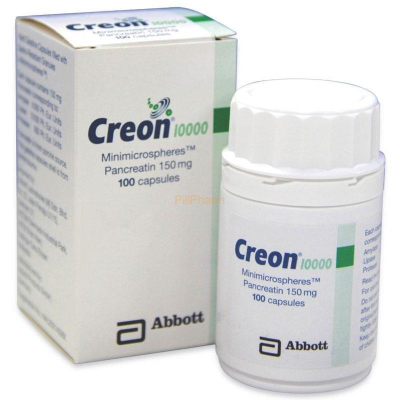
WHAT IS THIS MEDICINE?
Creon contains pancrelipase — a mixture of digestive enzymes
(lipase, amylase, and protease) derived from porcine (pig) pancreas. It
replaces the enzymes that a damaged or removed pancreas cannot produce,
enabling the digestion and absorption of fats, proteins, and carbohydrates.
It is used in pancreatic exocrine insufficiency (PEI) caused
by cystic fibrosis, chronic pancreatitis, pancreatic cancer, or pancreatectomy.
2. HOW TO TAKE THIS MEDICINE
Swallow the capsules whole with meals and snacks. For
patients who cannot swallow capsules, open and sprinkle the granules onto a
small amount of acidic soft food (apple sauce, yoghurt) — do not chew or crush
the granules. Dose is adjusted based on stool consistency and fat malabsorption
symptoms.
Pancreatic insufficiency, cystic fibrosis:
Oral: Initial:
Lipase 500 units/kg/meal, titrate dose based on individual response. For each
snack, administer half the prescribed mealtime dose.
Usual dose: Lipase 500 to 4,000 units/g of fat daily or lipase
500 to 2,500 units/kg/meal and lipase 250 to 1,250 units/kg/snack. Maximum
dose: Lipase ≤2,500 units/kg/meal or lipase ≤10,000 units/kg/day or lipase
<4,000 units/g of fat daily.
Higher dosages may be administered if documented to be effective by fecal
fat measures or an improvement in signs and symptoms of malabsorption,
including measures of nutritional status
Pancreatic insufficiency, non-cystic fibrosis conditions (eg, chronic
pancreatitis, pancreatectomy):
Oral: initial lipase 500 – 1000 units/kg/meal with individualized dosage
titrations.
3. POSSIBLE SIDE EFFECTS
Common side effects include the following. Contact your
doctor or pharmacist if any side effect worries you.
|
Side Effect |
Frequency |
What To Do |
|
Abdominal pain |
Common |
Usually improves with dose adjustment |
|
Nausea |
Common |
Take with meals; report if persistent |
|
Constipation |
Common |
Ensure adequate fluid intake |
|
Diarrhoea |
Common |
Dose may need adjustment; consult doctor |
|
Flatulence |
Common |
Usually improves as the dose is optimised |
|
Fibrosing colonopathy |
Rare (high doses) |
Use the lowest effective dose; do not exceed
recommended limits |
|
Hyperuricaemia |
Rare |
Monitor uric acid in gout-prone patients |
|
⚠ IMPORTANT WARNING |
|
Fibrosing colonopathy (scarring of the large
bowel) has been reported in children with cystic fibrosis using very high
doses of pancreatic enzymes. Do not exceed recommended doses. Any abdominal
pain, bloating, or change in bowel habits should be reported promptly. |
4. WHO SHOULD NOT TAKE THIS MEDICINE
Creon is derived from pork — not suitable for patients who are allergic
to pork products. Hypersensitivity to pancrelipase or any component of the
formulation; acute pancreatitis; acute exacerbation of chronic pancreatitis.
5. DRUG INTERACTIONS
Creon may reduce the absorption of some oral antivirals
(aciclovir). It may increase insulin requirements in diabetic patients by
improving carbohydrate absorption. No other significant interactions are
well-established.
6. HOW TO STORE
Store below 25°C. Keep the bottle tightly closed. Do not
refrigerate. Protect from moisture and heat.
7. PRESCRIPTION STATUS
Prescription Only Medicine (POM). Dose titration is best
managed by a gastroenterologist, dietitian, or specialist nurse familiar with
pancreatic insufficiency.
|
💚 PATIENT TIP |
|
Always take Creon at the START of your meal and
with any snacks — not after eating. If taken too late, food passes through
before the enzymes can act, and you will not absorb nutrients properly. |
8. PHARMACIST'S NOTE
Educate patients that Creon granules must never be crushed —
the enteric coating protects enzymes from gastric acid destruction. Counsel
patients that protein pump inhibitors (PPIs) are often co-prescribed to improve
Creon effectiveness by reducing gastric acid. Dose should match the fat content
of the meal.
9. FREQUENTLY ASKED QUESTIONS
|
FREQUENTLY ASKED QUESTIONS |
|
Q: What conditions does Creon need? A: Cystic fibrosis, chronic pancreatitis, after
pancreatic surgery (including Whipple's procedure), pancreatic cancer, and
occasionally after stomach or bile duct surgery. |
|
Q: How do I know if my
Creon dose is right? A: If your stools are pale, greasy, floating,
or smell strongly, the dose may be too low. If you are constipated or have
abdominal pain, it may be too high. Your dietitian or gastroenterologist will
guide dose titration. |
|
Q: Can vegetarians or
vegans take Creon? A: Creon is derived from pork pancreas and is
not suitable for vegans or those who avoid pork for religious reasons.
Discuss alternatives with your doctor, though no equivalent plant-based
pancreatin currently exists. |
|
Q: Can I take Creon with
a liquid meal or feed? A: Yes — for enteral feeds, Creon granules can
be mixed with a small amount of acidic fluid. Consult your dietitian for
specific guidance on enzyme dosing with tube feeds. |
|
Q: Will I be on Creon
forever? A: If the underlying cause of pancreatic
insufficiency is permanent (cystic fibrosis, chronic pancreatitis,
post-surgery), Creon is a lifelong treatment. |
There are no product reviews yet.