
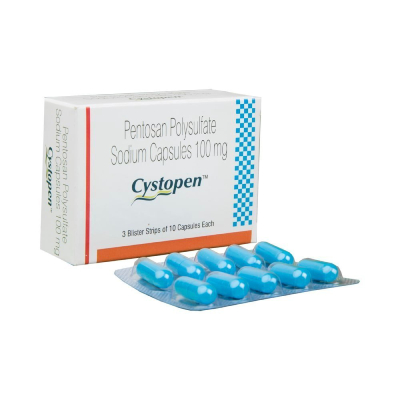
WHAT IS THIS MEDICINE?
Cystopen contains pentosan polysulfate sodium (PPS), a
semi-synthetic heparin-like compound. It is thought to work by adhering to and
restoring the glycosaminoglycan (GAG) layer — the protective mucous lining of
the bladder wall that is deficient in patients with interstitial cystitis (IC)
/ bladder pain syndrome (BPS). It is the only oral medicine specifically
licensed for this indication.
2. HOW TO TAKE THIS MEDICINE
Take ONE capsule (100mg) three times daily, one hour before
meals and two hours after eating. Swallow whole with water. Improvement may
take 3–6 months to become noticeable — do not discontinue prematurely. Maximum
benefit is usually seen at 6 months of continuous treatment.
3. POSSIBLE SIDE EFFECTS
Common side effects include the following. Contact your
doctor or pharmacist if any side effect worries you.
|
Side Effect |
Frequency |
What To Do |
|
Gastrointestinal upset (nausea, diarrhoea) |
Common |
Take with a small amount of food or reduce the dose
temporarily |
|
Alopecia (hair loss) |
Common |
Usually reversible on stopping treatment |
|
Rectal bleeding/haemorrhage |
Uncommon |
Report any rectal bleeding immediately |
|
Abnormal liver enzymes |
Uncommon |
Monitor liver function periodically |
|
Bruising / prolonged bleeding |
Uncommon |
PPS has mild anticoagulant properties |
|
Maculopathy (retinal damage) |
Rare (long-term) |
Annual eye examination recommended after 3
years of use |
|
Headache |
Common |
Usually mild and transient |
|
⚠ IMPORTANT WARNING |
|
Long-term use of PPS (typically over 3 years)
has been associated with a rare form of macular degeneration (pigmentary
maculopathy) that can affect vision. Annual ophthalmological review is
recommended for patients on long-term therapy. Report any vision changes promptly. |
4. WHO SHOULD NOT TAKE THIS MEDICINE
Contraindicated in known hypersensitivity to PPS, active
bleeding, or conditions predisposing to haemorrhage. Use with caution in
patients with liver disease, coagulopathies, or those on anticoagulant therapy.
Not recommended in pregnancy or breastfeeding without specialist advice.
5. DRUG INTERACTIONS
PPS has mild anticoagulant and antiplatelet activity —
concurrent use with anticoagulants (warfarin, heparin, DOACs) or antiplatelet
drugs (aspirin, clopidogrel) increases bleeding risk. Monitor closely. Aspirin
concurrent use requires particular care.
6. HOW TO STORE
Store below 25°C in original packaging. Protect from moisture
and light. Keep out of reach of children.
7. PRESCRIPTION STATUS
Prescription Only Medicine (POM). Treatment is initiated by
urologists or specialists in bladder pain syndrome. Ongoing prescriptions may
be managed in primary care.
|
💚 PATIENT TIP |
|
Take Cystopen at the same three times each day
and stick to the timing around meals. Setting phone alarms for each dose
helps maintain consistency, which is important for rebuilding the bladder's
protective lining over time. |
8. PHARMACIST'S NOTE
Counsel patients that the benefit of Cystopen is delayed —
patience is required. Hair loss (alopecia) is a common, reversible side effect
that often resolves with dose reduction or stopping. Advise patients on
long-term therapy to have annual eye checks. The mild anticoagulant activity
should be noted when co-prescribing any blood-thinning agents.
9. FREQUENTLY ASKED QUESTIONS
|
FREQUENTLY ASKED QUESTIONS |
|
Q: How long until I feel
better? A: Improvement typically takes 3–6 months.
Clinical trials showed continued improvement at 6 months. Do not stop
treatment early if you do not see immediate results. |
|
Q: Is my hair loss from
Cystopen permanent? A: No — alopecia (hair loss) caused by PPS is
reversible. Hair typically regrows after the dose is reduced or the medicine
is stopped. |
|
Q: Why do I need eye
checks? A: Long-term (3+ years) use of PPS has been
linked to a rare form of retinal pigment epithelium damage (pigmentary
maculopathy). An annual ophthalmology review is recommended to detect this early
when it is still manageable. |
|
Q: Can I take it with
other bladder medicines? A: Yes — Cystopen is often combined with other
IC treatments (bladder instillations, amitriptyline, hydroxyzine). Confirm
compatibility with your urologist. |
There are no product reviews yet.